
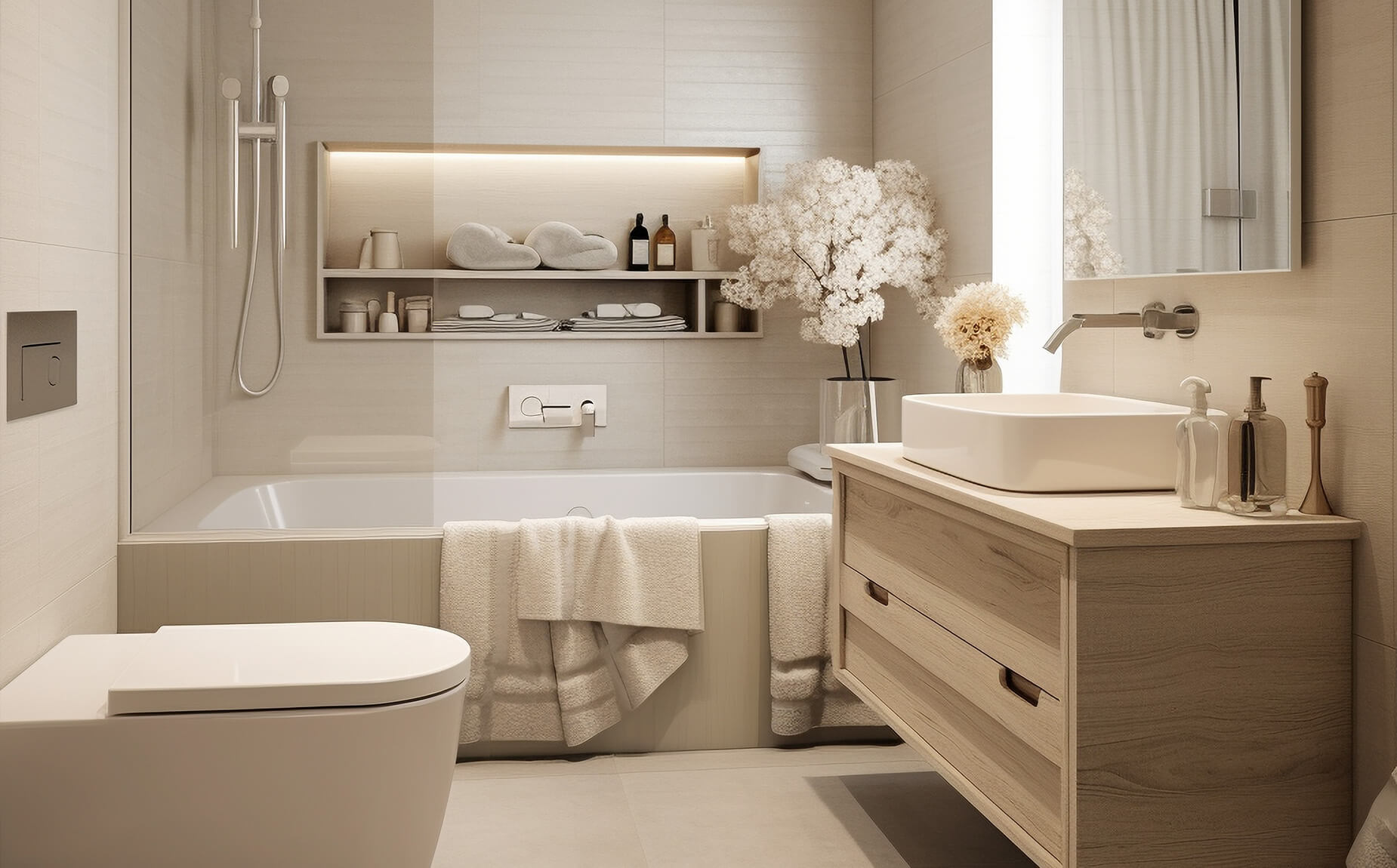
You tidy. You donate. You fold, sort, and put things away. Your surfaces are mostly clear. Your floors are visible. By all objective measures, your home isn’t cluttered.
And yet… it feels cluttered.
It feels busy. It feels visually loud. It feels like your eyes never get to rest.
This is one of the most confusing experiences people have with their homes, the sense of clutter without the presence of actual mess. And the truth is, clutter isn’t just about quantity. It’s about how a space behaves, how it communicates, and how it makes you feel.
If your home feels cluttered even when it’s clean, here’s what might really be happening.
There are too many “small things” and not enough visual anchors
A room needs a few strong, grounding elements — pieces with presence. Without them, the eye jumps from object to object, trying to make sense of the space.
Even if each item is beautiful, too many small-scale pieces create visual noise.
What this looks like:
- Lots of small décor items
- Petite furniture pieces
- Many little frames instead of one or two larger artworks
- A collection of objects that don’t relate to each other
Why it feels cluttered: Your brain is processing dozens of micro‑details instead of a few clear focal points.
The color palette is too busy or too scattered
Color is one of the biggest contributors to visual clutter, even when the room is spotless.
If every object introduces a new color, tone, or pattern, the space becomes fragmented.
What this looks like:
- A mix of unrelated hues
- Patterns that compete instead of complement
- Décor bought piece-by-piece without a palette in mind
Why it feels cluttered: Your eye can’t find harmony. It’s like listening to a song where every instrument is playing a different melody.
The room lacks negative space
Clutter isn’t just about what’s there, it’s about what’s not there.
Negative space (empty space) is what gives a room breathing room. Without it, even a well-decorated space feels cramped.
What this looks like:
- Every shelf filled
- Every wall decorated
- Every corner occupied
- Furniture placed without room to “exhale”
Why it feels cluttered: Your eye never gets a moment of rest. Everything is asking for attention at once.
The furniture layout is working against you
Sometimes the cluttered feeling comes from flow, not objects.
What this looks like:
- Furniture blocking natural pathways
- Too many pieces in one zone
- A layout that forces you to zigzag around the room
- Items that don’t relate to the architecture
Why it feels cluttered: Your body feels the chaos before your mind does. A room that’s hard to move through always feels more cluttered than it is.
There isn’t enough vertical storage
A home can feel cluttered when everything you own sits at the same height. When storage lives mostly on the floor or at eye level, the room becomes visually dense, even if the number of items is perfectly reasonable. Introducing vertical storage, shelves, tall cabinets, wall-mounted units, redistributes the visual weight of the room. It lifts the eye upward, creates breathing space at ground level, and gives the entire space a calmer, more structured rhythm.
Sometimes the solution isn’t owning less, but storing differently.
The real reason: clutter is a feeling, not a quantity
A home can be tidy and still feel overwhelming. It can be minimal and still feel chaotic. It can be clean and still feel “too much.”
Clutter is emotional. Clutter is sensory. Clutter is the relationship between objects, not the number of them.
When you shift from “Do I have too much stuff?” to “How does this space behave?” everything becomes clearer.
Your home doesn’t need fewer things, it needs the right things, arranged with intention, breathing room, and harmony.
